Contact for Negotiation Skills Training for your Teams: contact@advanchainge.com | +91-9873829286

Mastering Negotiation BATNA and ZOPA - A Complete Guide
Unlock the power of Negotiation BATNA and ZOPA to gain leverage, set strong limits, and close better deals. A practical, expert-backed guide for smarter decision-making.
SCIENCE OF NEGOTIATIONNEGOTIATION STRATEGIESPRINCIPLED NEGOTIATIONNEGOTIATION SKILLSPERSUASIVE NEGOTIATIONWALK AWAY FROM A DEALWIN-WIN NEGOTIATIONROGER FISHER
Ashish Mendiratta
12/7/202511 min read
Most people discover the power of negotiation the hard way—usually after walking out of a conversation thinking, “I should’ve asked for more,” or “I shouldn’t have agreed to that.” But every once in a while, there’s a moment that changes how you approach deals forever.
A BATNA Story That Reveals More Than Any Definition
A senior sales manager I once worked with told me about a negotiation early in his career. His company was desperate to win a large distributor contract. He walked in eager, overly accommodating, and ready to close. The distributor sensed it immediately and kept tightening the terms—more credit, deeper discounts, tougher delivery commitments.
Feeling cornered, he accepted almost everything. Months later, the contract ended up costing more than it earned.
Years later, faced with a similar negotiation, he approached it differently. This time, before he walked into the room, he asked himself a question he had never bothered to consider the first time:
“What will I do if this deal doesn’t happen?”
He outlined alternatives. He knew his limits. He understood their likely limits too. And something remarkable happened—he no longer negotiated with fear. He negotiated with clarity.
This raises the real questions:
What changes when you know your alternatives?
Why does negotiation feel easier when you know your limits?
And how do both sides’ boundaries quietly shape where a deal can land?
Those questions lead us straight into the heart of negotiation strategy: BATNA, ZOPA, and the Reservation Point.
BATNA: The Power You Bring Without Saying a Word
Let’s start with the concept that transforms negotiation psychology long before a single word is spoken.
BATNA—your Best Alternative To a Negotiated Agreement—is simply the path you will take if the current deal falls apart.
It is not about threats, bluffing, or theatrics. It’s about knowing you are not trapped.
Think of BATNA as silent confidence. You don’t announce it like a weapon; you carry it like posture.
A Real Moment of BATNA in Action
A mid-level manager named Meera was negotiating a vendor renewal for a service contract. The vendor pushed for a steep increase. Meera didn’t argue, didn’t panic, didn’t defend. She simply said she’d need to review it.
What the vendor didn’t know was that Meera had quietly lined up two comparable service providers who had offered a lowered price. She knew that she had other options if the negotiation with this vendor fails to go through. She knew that she didn't have to agree on any price that is more than the lowest price offered. When she returned to the discussion, she wasn’t arrogant—she was steady.
Her calmness alone shifted the tone.
The vendor lowered the increase dramatically. What changed?
Not the vendor.
Not the market.
Meera changed—because she understood her alternatives.
A strong BATNA doesn’t make you aggressive. It makes you uncompelled. When you don’t have to take a deal, you negotiate differently. And the other side senses it—always.
BATNA Protects you from:
Accepting an offer worse than your best alternatives
Walking away from an offer better than your best alternative


Reservation Point: The Line You Never Cross
If BATNA gives you freedom, the Reservation Point gives you discipline.
Your reservation point is the quiet boundary where you say,
“Anything worse than this, and I’m better off walking away.”
It’s not emotional.
It’s not improvisational.
It’s not designed during the negotiation.
It’s determined long before.
The House That Taught a Couple Their Reservation Point
A couple I know spent months searching for a home. They eventually found one that felt perfect—sunlit rooms, a lovely kitchen, everything they had imagined. Emotionally, they were sold. But financially, they weren’t sure.
So they sat down with numbers, projected their cash flow, calculated loan stress, and came up with a firm limit: ₹1.32 crore.
That was their reservation point. It could be an alternative offer available from another seller or your budget constraint.
When the seller refused to drop below ₹1.36 crore, they walked away—heartbroken but firm. Two weeks later, the seller called them back at ₹1.30 crore.
Had they let emotion guide them, they would have overshot their limit.
Their reservation point protected them from themselves.
Think of BATNA as your parachute.
Think of the reservation point as the ground on which you refuse to crash.
Together, they keep you safe.
ZOPA: The Space Where Deals Are Actually Born
Now let’s look at how deals really form.
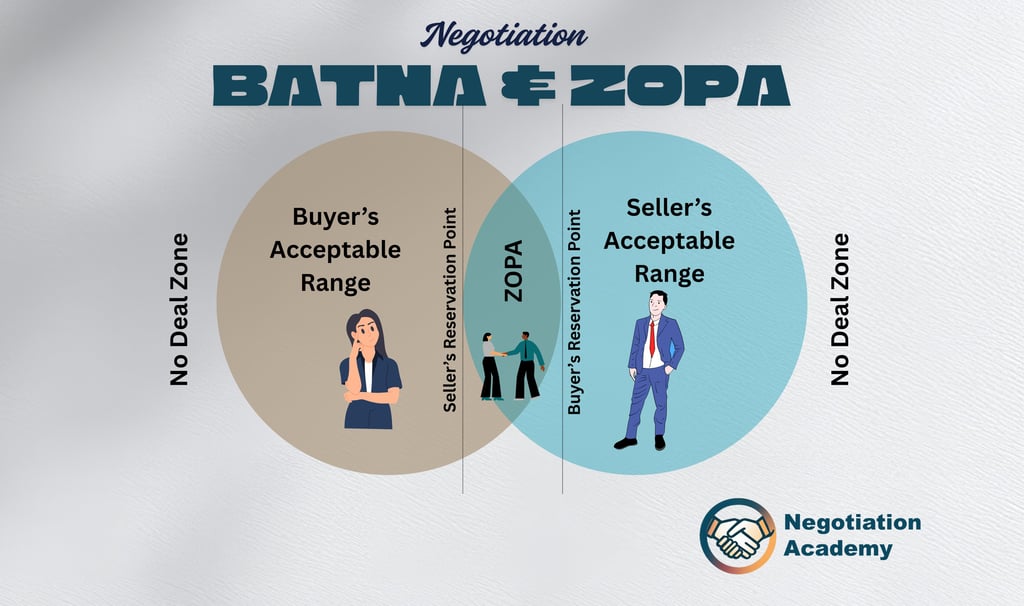
Every negotiation has two invisible lines:
Your reservation point
Their (your seller's or buyer's) reservation point
Where those lines overlap, a deal becomes possible.
This overlap is called ZOPA—the Zone of Possible Agreement.
Most negotiation tension, confusion, and frustration happen because people don’t know whether such a zone even exists.
A Simple Illustration from a Salary Negotiation
A candidate may need a minimum of ₹20 lakh to accept a job but has an aspirational target of ₹25 lakh .
A company may be want to hire at ₹18 lakh but prepared to pay up to ₹23 lakh.
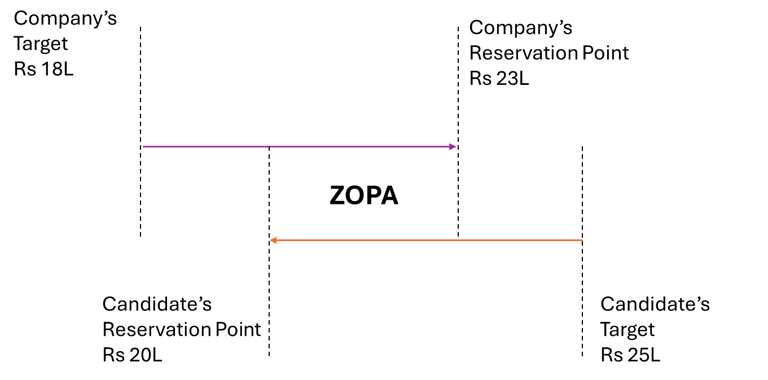
Between ₹20–23 lakh lies the ZOPA. This is the range where both sides can say “yes” without losing.
But imagine a different case:
Candidate needs ₹24 lakh minimum.
Company can only stretch to ₹22 lakh.
There’s no overlap. No ZOPA. No deal—unless someone changes their expectations or strengthens their BATNA.
It’s the same in B2B contracts, vendor discussions, partnership talks, and even internal negotiations over deadlines and resources.
Deals don’t necessarily fail because people misbehave or hold to their positions.
Deals fail because the ZOPA doesn’t exist—or nobody bothers to discover it.
A Full Story Showing BATNA, Reservation Point and ZOPA Working Together
To see how BATNA, reservation point, and ZOPA quietly shape a negotiation, let me share a story from a manufacturing client who was renewing a contract with a long-time equipment maintenance partner.
Their operations head, Neel, had worked with this vendor for years. The relationship was strong, the service dependable, and the annual renewal usually a formality. But this time, the vendor came in with a proposal that shocked everyone—an 18% price increase. They blamed rising labor shortages, compliance costs, and new safety requirements.
In the past, Neel might have swallowed the increase just to avoid disruption. But this time he did something different. Weeks before the negotiation, he had quietly explored alternatives, met two new vendors, and even piloted a small test assignment with one of them. He didn’t do this to threaten anyone; he did it to understand his real choices. That exploration became his BATNA—his best alternative if the renewal fell through.
He also calculated his reservation point. Between budget constraints and internal cost targets, the maximum increase the business could absorb was 8%. Anything beyond that, he knew, would damage profitability. He set this limit early, long before he entered the negotiation room.
But Neel didn’t stop there. He tried to understand the vendor’s world too—market wages, industry maintenance rates, cost trends. From this, he estimated the vendor’s likely reservation point. He guessed they might settle for something around a 6–9% increase if pushed with facts instead of emotion. That allowed him to map a tentative ZOPA i.e. 6% to 8%—the range where both sides could realistically say yes.
So when the vendor demanded an 18% increase, Neel didn’t flinch. He didn’t argue. He simply listened, asked questions, and calmly shared what he knew: market rate trends, internal benchmarking, service-level challenges, and yes, the fact that the company had explored other maintenance partners. The tone wasn’t confrontational—just steady.
The vendor’s confidence softened almost immediately. Their “18%” was never intended to be final—it was an opening anchor. Once they sensed Neel wasn’t negotiating out of fear or obligation, the conversation shifted into problem-solving instead of posturing. The vendor lowered their number to 12%, then 9%, and ultimately agreed to a renewal at 7%—comfortably within Neel’s reservation point and well aligned with the ZOPA he had quietly mapped.
Nothing about the vendor changed that day. Neel changed.
He walked into the negotiation with alternatives, with boundaries, and with an understanding of the likely overlap between the two sides. That preparation—much more than persuasion—shaped the outcome.
Developing and Applying BATNA, Reservation Point & ZOPA — A Practical Guide
The Process for Determining Your BATNA
A clearly defined BATNA strengthens negotiating power by preventing acceptance of unfavourable terms and enabling more assertive, evidence-based decisions. The process below follows the classical framework (Fisher & Ury) and expands it into a step-by-step method suitable for commercial or organizational negotiations.
Step 1 — Define the objective and scope.
Clarify the exact outcome you seek from the negotiation and gather all relevant stakeholders to align priorities. Define the non-negotiables (must-haves), desirable outcomes, and acceptable trade-offs. This ensures the BATNA assessment is focused and linked to strategic goals rather than ad-hoc wishes.
Step 2 — Systematic brainstorming of alternatives.
List all plausible alternatives that you could pursue if the negotiation fails. Include direct substitutes (other suppliers, different partners), process changes (phased implementation, revised timelines), and structural options (outsourcing, internal reallocation). Avoid assuming the other party’s intentions during this stage; generate options independently and exhaustively.
Step 3 — Rigorous evaluation of alternatives.
Assess each alternative for feasibility, cost, time-to-implement, operational impact, and risk. Use quantitative modelling where possible (NPV, TCO, capacity constraints) and validate assumptions with market checks. Rank alternatives by expected value and implementation risk to identify the most viable fallback.
Step 4 — Improve and validate the leading options.
Convert promising alternatives into realistic plans: obtain preliminary quotes, test small-scale pilots, secure conditional commitments, or draft contingency contracts. Strengthening alternatives increases their credibility and converts hypothetical options into genuine leverage.
Step 5 — Select and document the BATNA.
Choose the single best alternative and document the steps required to implement it. Record timelines, costs, required approvals, and dependencies. Treat the documented BATNA as a working plan that can be executed if the negotiation reaches an impasse.
Estimating the Other Party’s BATNA
Estimating the counterpart’s BATNA is essential to anticipate their flexibility and likely thresholds. Because direct disclosure is unlikely, rely on structured inference rather than guesswork.
Market and competitive analysis. Examine industry capacity, competitor behaviour, recent transactions, and pricing trends. Indicators such as excess capacity, declining demand, or multiple bidders suggest a weaker BATNA for the other party; constrained capacity, backlogs, or strategic exclusivity suggest a stronger BATNA.
Public and private signals. Review public filings, trade press, supply chain data, and social channels for procurement activity or business stress. Monitor hiring, plant utilisation, inventory levels, or credit terms as indirect signals of their alternatives.
Behavioral and negotiation cues. Observe their anchoring, concession pattern, and urgency. Repeated insistence on tight terms, rapid deadlines, or refusal to consider trade-offs may imply limited acceptable alternatives—or conversely, a deliberate anchoring strategy supported by a strong BATNA.
Verification through targeted inquiry. Use calibrated questions, conditional offers, and exploratory probes to reveal constraints without revealing your own BATNA. Where permissible, use market tests (requests for information, parallel sourcing) to obtain confirming evidence.
Estimate the counterpart’s BATNA as a range (best-case to worst-case) rather than a single point, and update that estimate as new information emerges during dialogue.
Determining Reservation Points
The reservation point is the minimum (or maximum) acceptable term beyond which the negotiator will opt for their BATNA. Establishing it requires objective analysis and market-informed judgement.
Align reservation point with BATNA. The reservation point must be strictly better than the BATNA; otherwise, acceptance would be irrational. Calculate the economic and strategic breakeven where the negotiated outcome equals the value (monetary and non-monetary) of executing the BATNA.
Use market intelligence to ground the decision. Incorporate benchmark pricing, index trends, input-cost movements, competitor deals, and relevant macro indicators. Market intelligence corrects optimism bias and prevents setting a reservation point that is either unattainable or unnecessarily conservative.
Quantify trade-offs and scenario-test. Run sensitivity analyses for key variables (price, volume, service level, lead time). Determine how changes in these variables shift the reservation point. Consider direct costs, indirect operational impacts, reputational factors, and option value (e.g., preserving capacity for future opportunities).
Decide non-monetary boundaries. Reservation points should include qualitative thresholds (service levels, warranty terms, IP protections, exclusivity clauses). Document these alongside price limits so decisions are taken holistically rather than by a single metric.
Keep the reservation point confidential. It is an internal control that prevents opponents from anchoring the negotiation to your minimum. Communicate only the outcomes you wish to explore, not the limit you must defend.
Best Practices for Using BATNA, Reservation Point & ZOPA
These practices translate concepts into consistent, repeatable behaviour that improves outcomes and reduces negotiation risk.
Prepare comprehensively before the table. Allocate time and resources to research, scenario planning, and BATNA development. Preparation is the principal determinant of leverage.
Document assumptions and decision rules. Capture the data, sources, and calculations that produced your BATNA and reservation point. This documentation supports repeatable decision-making and auditability.
Strengthen BATNA proactively. Where possible, move alternatives from theoretical to executable: secure provisional offers, pilot agreements, or internal reallocations that can be implemented quickly if needed.
Model ZOPA dynamically. Treat ZOPA as an evolving estimate. Use early offers and calibrated concessions to probe the overlap and adjust strategy, rather than attempting to declare a fixed zone in advance.
Apply market intelligence continuously. Update BATNA and reservation point as new market data arrives; do not treat them as immutable once the negotiation begins.
Avoid revealing internal thresholds. Maintain confidentiality around reservation points and the relative strength of BATNAs. If you must disclose information, do so strategically to shape perceptions without eroding flexibility.
Communicate alternatives credibly, not threateningly. If referencing alternatives is necessary, present them factually and professionally to alter the dynamic without creating adversarial escalation.
Use trade-offs to expand ZOPA. When a direct overlap is narrow or absent, introduce additional variables (payment terms, volume commitments, warranties, shared risk mechanisms) to create value and widen the feasible zone.
Plan walk-away procedures. Establish internal governance for executing on a BATNA (who approves, timing, communication plan). A credible willingness to walk away reinforces negotiating discipline.
Review and learn post-negotiation. After each negotiation, compare expectations to outcomes, refine modelling assumptions, and translate lessons into updated templates and playbooks.
Final Thoughts
A disciplined understanding of BATNA, reservation points, and ZOPA transforms negotiation from a reactive exchange into a structured decision-making process. These tools enable negotiators to separate strategy from emotion, evaluate proposals with clarity, and pursue agreements that create value without compromising essential interests. When applied with preparation, market intelligence, and consistent internal alignment, they provide a stable foundation for achieving outcomes that are both commercially sound and strategically aligned. Ultimately, successful negotiation is not about winning every point, but about making informed choices that support long-term objectives while maintaining professional credibility and balance.
Frequently asked questions
1. What is BATNA in negotiation, and why is it important?
BATNA (Best Alternative to a Negotiated Agreement) is the option you will pursue if the current negotiation fails. It is important because it prevents you from accepting a deal that is worse than your alternatives and gives you confidence and leverage during negotiations.
2. What is ZOPA in negotiation?
ZOPA (Zone of Possible Agreement) is the range where both parties’ reservation points overlap. A deal is possible only within this zone; outside it, no agreement can be reached unless one side changes its expectations or improves its BATNA.
3. What is the difference between BATNA and ZOPA?
BATNA is your fallback option if no deal is reached, while ZOPA is the overlap between what both sides are willing to accept. BATNA defines when you should walk away; ZOPA defines whether a deal is possible at all.
4. What are BATNA and ZOPA examples?
A BATNA example is having another supplier ready if price negotiations fail with the current vendor. A ZOPA example is a salary negotiation where a candidate needs at least ₹20 lakh and the employer can pay up to ₹23 lakh—the overlap between ₹20–23 lakh is the ZOPA.
5. Why do negotiations fail even when both sides want a deal?
Negotiations often fail because no ZOPA exists, not because of poor communication. When the minimum acceptable outcome of one party does not overlap with the maximum acceptable outcome of the other, agreement is structurally impossible.
6. Should you reveal your BATNA in a negotiation?
Generally, you should not reveal your BATNA. Keeping it confidential prevents the other party from anchoring their offer to your minimum threshold. If mentioned at all, alternatives should be communicated factually and professionally—without threats—only to correct unrealistic expectations or reset the negotiation.
Subscribe
Contact:
P2/54 DLF Phase 2 Gurugram 122002
contact@advanchainge.com
+91-9873829286
deepak.nande@advanchainge.com
+91-9820291969